PSA vs CGC vs BGS: What Do Pokémon Card Grades Mean?
Quick answer
PSA, CGC and Beckett (BGS) all grade cards from 1 to 10, but a 10 means something slightly different at each. PSA's top grade is Gem Mint 10 and it marks single flaws with qualifiers; CGC splits its top into Pristine 10 and Gem Mint 10; BGS prints four subgrades and gives its Black Label only when all four are 10. Compare slabs at the same grader and grade.
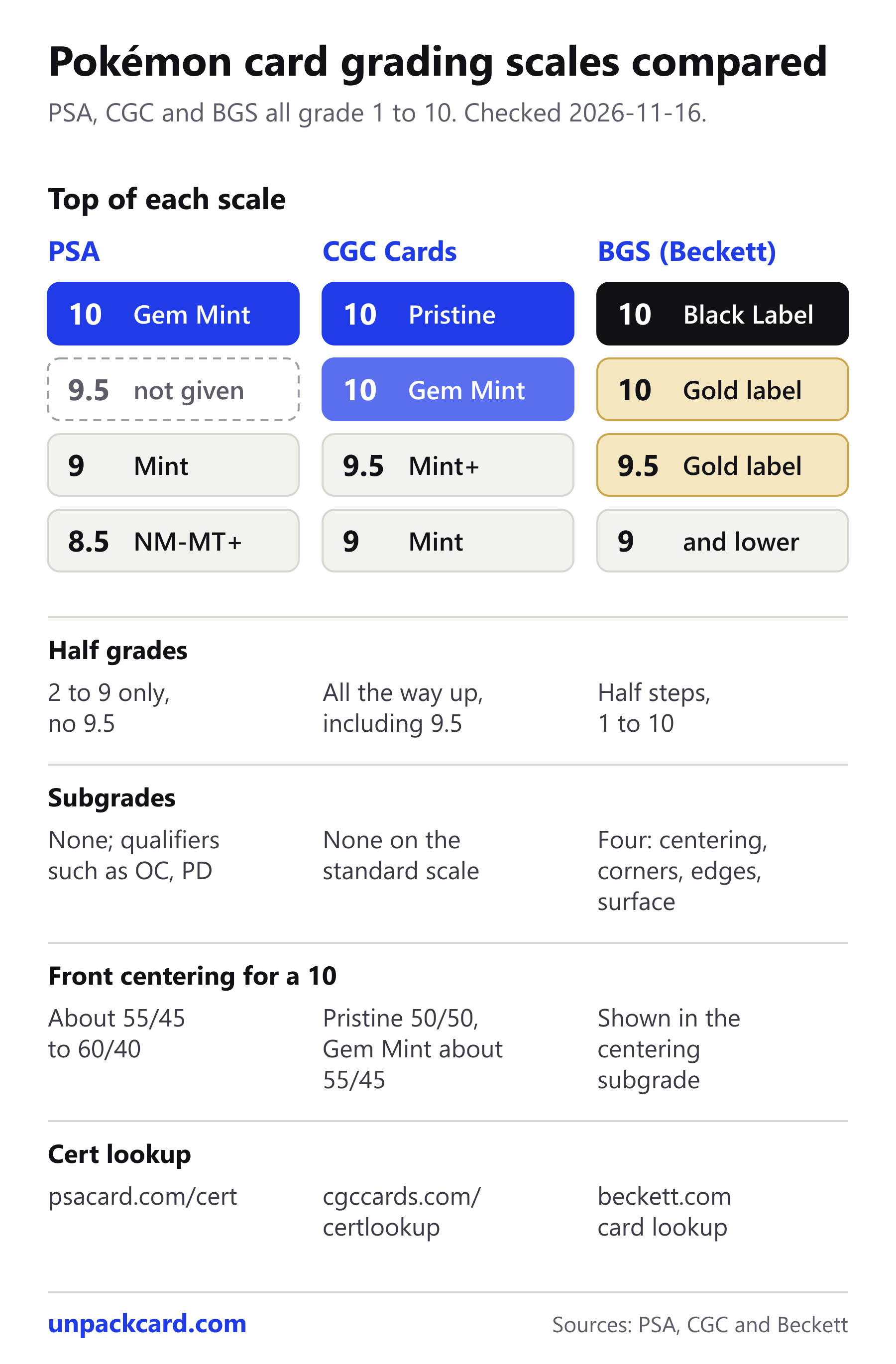
Use this graphic
Free to reuse under CC BY 4.0. Please credit UnpackCard (unpackcard.com) with a link to this page. The code below does both, or download the image.
On this page
What does PSA 10 GEM MT mean, and how is it different from PSA 9 MINT?
A PSA Gem Mint 10 is what PSA calls a virtually perfect card, while a PSA Mint 9 is a superb card with exactly one minor flaw. That one flaw can be a very slight wax stain on the back, a minor printing imperfection or slightly off-white borders.
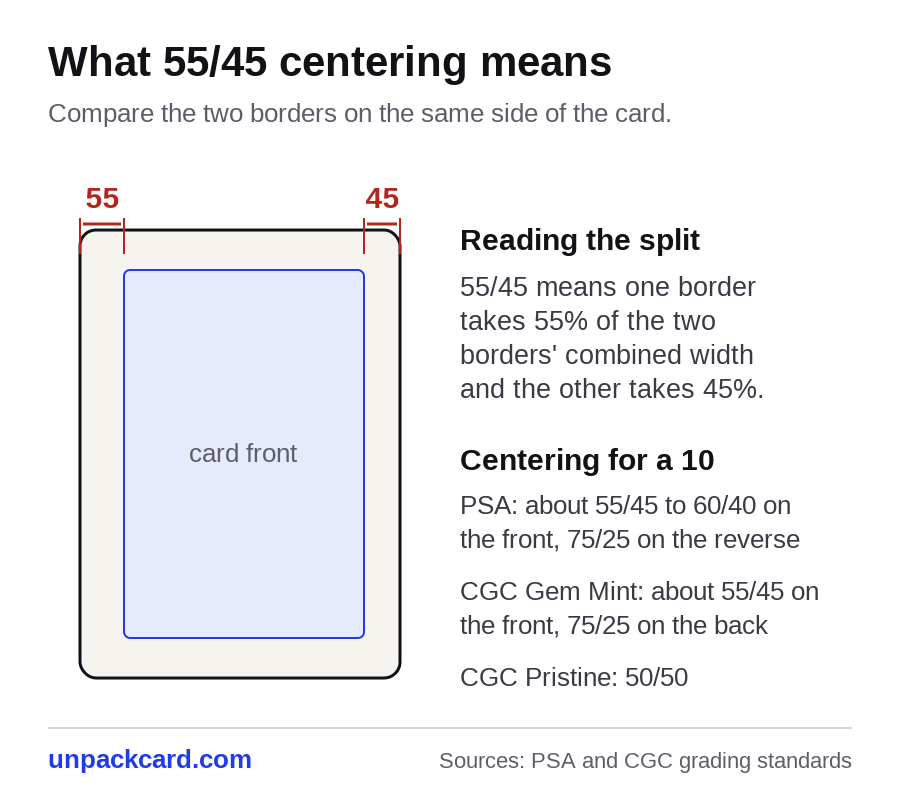
Centering is the rule most buyers check first. For a 10, PSA asks for the front image to sit within about 55/45 to 60/40 and the back within 75/25. For a 9, the front may be about 60/40 to 65/35 and the back 90/10. A split like 55/45 means one border takes 55 percent of the combined width of the two opposite borders and the other takes 45 percent.
PSA does not give a 9.5 to cards. Between Good 2 and Mint 9 it can add a half point to a card that is high-end for its grade, with what PSA calls a clear focus on centering, so you will see grades such as NM-MT+ 8.5. Below a 9, PSA NM-MT 8 looks like a 9 at first glance but may show the slightest fraying at one or two corners.
PSA can also add a qualifier code for one specific problem, such as OC for off-centre or PD for a print defect, and compare such a slab only with slabs carrying the same qualifier. PSA can decline to grade a card at all, for reasons its standards list such as evidence of restoration, recoloration, questionable authenticity, altered stock or cleaning.
What are CGC Pristine 10 and CGC Gem Mint 10?
CGC Pristine 10 is CGC's top label for a card that is virtually flawless with 50/50 centering, and CGC Gem Mint 10 is a 10 where one criterion falls short of Pristine. Both say 10, so read the words on the label, not only the number.
For Gem Mint 10, CGC asks for front centering of no more than about 55/45 and back centering of no more than 75/25. For Mint 9, the front must be 60/40 or better and the back 90/10. CGC uses half grades all the way up its scale, including Mint+ 9.5.
Older CGC slabs can confuse buyers. CGC says its earlier CGC Trading Cards Gem Mint 9.5 and CSG Gem Mint 9.5 grades are now treated as CGC Cards Gem Mint 10, and it no longer assigns its old Perfect 10 grade.
What are BGS subgrades and the Black Label?
BGS subgrades are four separate scores for centering, corners, edges and surface, and the Black Label is Beckett's top label for a Pristine 10 with a 10 in all four. BGS grades from 1 to 10 in half steps, and the overall grade comes from the four subgrades.
According to Beckett, a 9.5 or a 10 without four perfect subgrades gets a gold label instead, so read the subgrades printed on the label rather than the label colour alone.
Subgrades show where a card lost points. A BGS 9.5 with a 9 for centering and a 10 for surface looks different in hand from one with a 10 for centering and a 9 for surface, even though both say 9.5.
| PSA | CGC Cards | BGS (Beckett) | |
|---|---|---|---|
| Scale | 1 to 10; half grades from 2 to 9; no 9.5 | 1 to 10 with half grades, including 9.5 | 1 to 10 in half steps |
| Top label | Gem Mint 10 | Pristine 10, then Gem Mint 10 | Black Label Pristine 10 |
| Subgrades | None; qualifiers such as OC or PD | None on the standard scale | Four: centering, corners, edges, surface |
| Front centering for a 10 | About 55/45 to 60/40 | Pristine 50/50; Gem Mint about 55/45 | Shown in the centering subgrade |
| Cert lookup | psacard.com/cert | cgccards.com/certlookup | Card lookup on beckett.com |
What is each grade called at PSA and CGC?
Each grade number has a name, and the names differ between graders: a PSA 8 is NM-MT 8, while a CGC 8 is NM/Mint 8. The table lists every grade name from each grader's own published scale, from 10 down to 1.
PSA gives half grades only between Good 2 and Mint 9, for cards that are high-end for their grade, and never a 9.5. CGC gives half grades at every step, including Mint+ 9.5. Beckett grades BGS cards in half steps too and prints four subgrades, so read a BGS label by its subgrades as well as its overall grade.
| Grade | PSA name | CGC name |
|---|---|---|
| 10 | GEM-MT 10 (Gem Mint) | Pristine 10, or Gem Mint 10 |
| 9.5 | None for cards | Mint+ 9.5 |
| 9 | MINT 9 | Mint 9 |
| 8.5 | NM-MT+ 8.5 (half grade) | NM/Mint+ 8.5 |
| 8 | NM-MT 8 (Near Mint-Mint) | NM/Mint 8 |
| 7 | NM 7 (Near Mint) | Near Mint 7 |
| 6 | EX-MT 6 (Excellent-Mint) | Ex/NM 6 |
| 5 | EX 5 (Excellent) | Excellent 5 |
| 4 | VG-EX 4 (Very Good-Excellent) | VG/Ex 4 |
| 3 | VG 3 (Very Good) | Very Good 3 |
| 2 | GOOD 2 | Good 2 |
| 1.5 | FR 1.5 (Fair) | Fair 1.5 |
| 1 | PR 1 (Poor) | Poor 1 |
Which grader's slabs are most common in Malaysia's second-hand market?
No public data counts graded slabs in Malaysia by grader, so any share you read online is a guess. TCGTalk's 2026 Malaysia grading guide says PSA 10 is what buyers look for by default, which describes demand rather than how many slabs of each grader are in circulation.
You will see PSA, CGC and BGS slabs in Malaysian listings, alongside smaller graders. Whatever the grader, check the cert number on that grader's own site before you pay. Our guide on how to check a PSA slab is real covers the checks step by step, and where to buy graded cards in Malaysia covers the channels.
Can you get cards graded from Malaysia?
Yes, but the cards travel abroad to be graded, either sent by you or through a submission service. CGC said in April 2026 that it would accept card submissions at the Southeast Asia Super Collectors Convention in Kuala Lumpur on May 1 to 3, 2026, through its Official Submission Center in Malaysia, with cards sent insured to CGC in Sarasota, Florida and returned to that centre for pickup.
For PSA, the route is set by PSA itself. Its notice of 18 February 2026 says customers in the Asia-Pacific region, Malaysia included (Japan and China excluded), must submit cards through the PSA Hong Kong Submission Center, by courier or by appointment in person. PSA says the cards are graded to the same standards, and completed orders are returned to PSA Hong Kong rather than to a US address.
PSA's submission updates page, as of 2026-11-16, says its Value service reopened for new card submissions on October 29, 2026 with an estimated turnaround of 90 to 100 business days, that Value Bulk remains paused, and that Express and higher service levels are unchanged. Nothing on that page is specific to Malaysia.
If you use a submission service, get its fees, turnaround, insurance and return terms in writing before you hand over any card, and photograph every card front and back before it leaves your hands.
Does a higher grade always mean a higher price?
No. For the same card at the same grader a higher grade usually sells for more, but across graders the order often changes, and for some cards a lower grade sells close to a higher one.
TCGTalk's 2026 analysis of graded Pokémon prices in Malaysia, built on PriceCharting data, shows cards where a CGC 10 sold above a PSA 10 and others where it sold below, cards where a BGS 10 sold below a PSA 10, and cards where a PSA 9 sold above a CGC 10. The gap between grades also varies a lot from card to card.
So the fair way to judge a slab's asking price is recent sold prices for the exact card, grader and grade, across several sales. Past prices do not tell you what a card will be worth later, and a grade describes condition, not a future price.
How do you read a graded slab label?
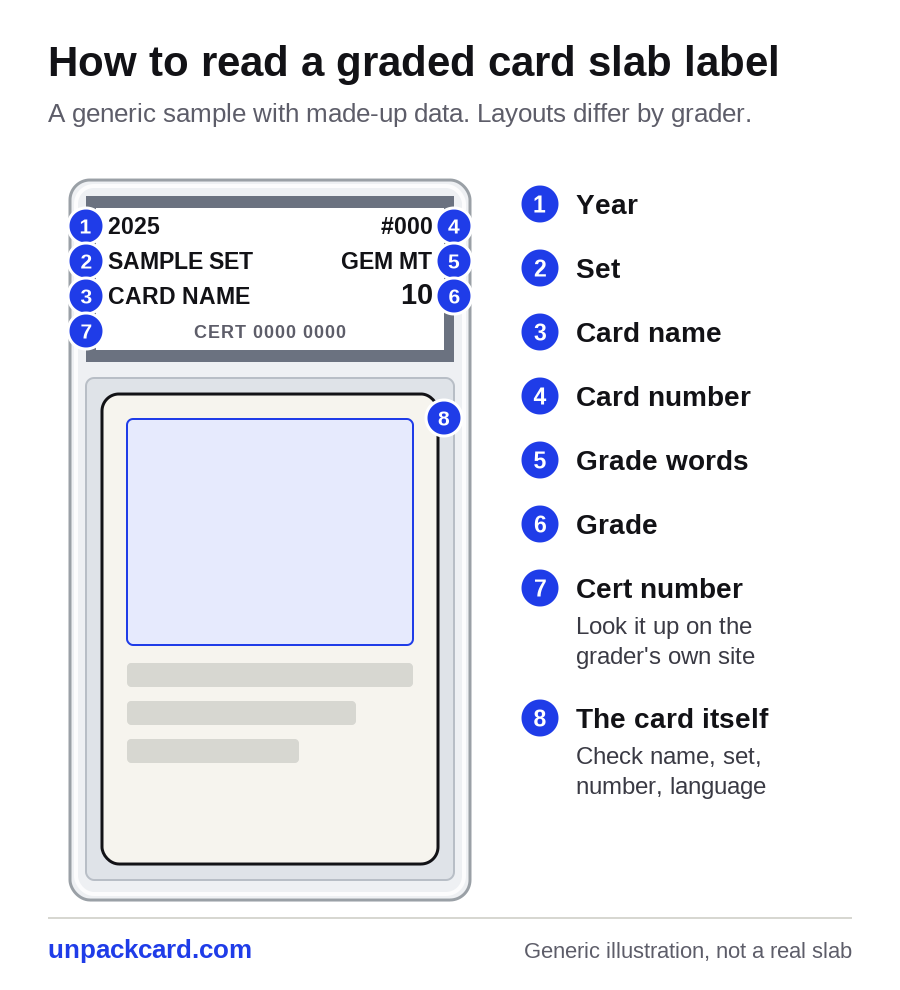
Every slab label names the card, its set and card number, the grade in words and as a number, and a unique certification number. Start with the cert number, because it is the key to checking the slab on the grader's own website.
Check the Pokémon's name, the set, the card number and the language against the card you can see through the case. Then read the grader-specific parts: a qualifier after a PSA grade, Pristine or Gem Mint on a CGC 10, and the four subgrades on a BGS label. For anything else, our help page answers common questions. Once a slab checks out, keep it upright, dry and out of the sun; our guide on storing Pokémon cards and slabs explains why.
Where do graded slabs fit on UnpackCard?
UnpackCard, the site publishing this guide, is a Pokémon TCG shop in Malaysia. Its Shop lists graded slabs and sealed product bought to order, mainly from a Malaysian distributor and also from established online sellers; you can browse now, and ordering opens soon. Demo: no real payments, nothing ships yet.
Whoever you deal with, including us, ask for the cert number of any slab and check it on the grader's own site before you decide. If you are new to the symbols on raw cards, our guide to Pokémon card rarity symbols explains them.
Sources
- PSA: card grading standards
- PSA: pricing and estimated turnaround time updates
- PSA: new submission process for APAC customers (18 February 2026)
- CGC Cards: grading scale
- CGC: submissions at the Southeast Asia Super Collectors Convention 2026
- Beckett: introducing BGS Black (Black Label rules)
- TCGTalk: card grading companies for Malaysian collectors (2026)
- TCGTalk: graded card premium analysis, Malaysia (2026)