How Do I Check if a PSA Slab Is Real?
Quick answer
To check if a PSA slab is real, type the certification number from the label into PSA's cert verification page at psacard.com/cert and confirm the card, year, set, number and grade all match the slab in front of you. Then check the label printing, the holder's seal and the hologram, because fakes copy real cert numbers. Get the cert number before you pay.
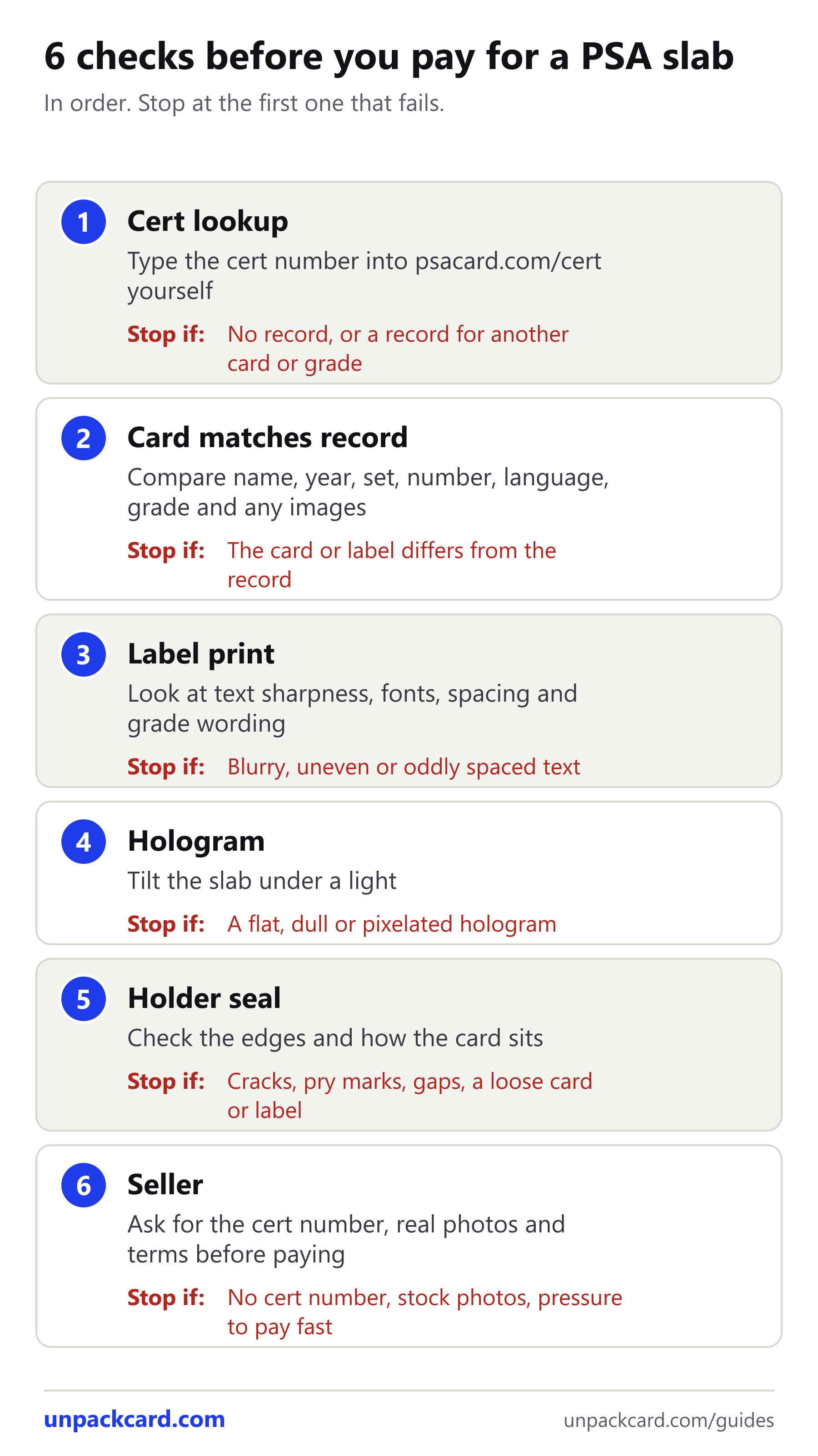
Use this graphic
Free to reuse under CC BY 4.0. Please credit UnpackCard (unpackcard.com) with a link to this page. The code below does both, or download the image.
On this page
How do I look up a PSA cert number?
Type psacard.com/cert into your browser yourself, enter the certification number printed on the slab's label, and open the record. The lookup is free, and the record should describe exactly the card in the case.
Compare the record line by line with the label and the card: the Pokémon's name, the year, the set, the card number, the language and the grade. A match means every one of these agrees. PSA's FAQ says that since 2019 it has scanned the front and back of slabs it grades at most service levels and shows those images on the Cert Verification page, so many records include photos. Where they do, compare them too: the centering, any print marks and the label should look like the slab you are being offered. Older slabs may have no images.
You can also check from PSA's own app. According to PSA's FAQ, the PSA App verifies a cert in two ways: scan the PSA label or its QR code with the app, or type the cert number, and the app pulls up the certification details. Install the app from your phone's official app store, and check that the number the app shows is the same as the one printed on the label.
A 'not found' result, a record for a different card or a different grade means stop. Re-type the number once to rule out a typing mistake, and if it still does not match, walk away.
| Check | What to do | Stop if |
|---|---|---|
| 1. Cert lookup | Type the cert number into psacard.com/cert yourself | No record, or a record for another card or grade |
| 2. Card matches record | Compare name, year, set, number, language, grade and any images | The card or label differs from the record |
| 3. Label print | Look at text sharpness, fonts, spacing and grade wording | Blurry, uneven or oddly spaced text |
| 4. Hologram | Tilt the slab under a light | A flat, dull or pixelated hologram |
| 5. Holder seal | Check the edges and how the card sits | Cracks, pry marks, gaps, a loose card or label |
| 6. Seller | Ask for the cert number, real photos and terms before paying | No cert number, stock photos, pressure to pay fast |
What if the cert number is real but the card is different?
Then the slab is not genuine, however good the lookup looks. A real record proves that a slab with that number exists somewhere, not that the slab in your hand is it.
Counterfeiters copy cert numbers from real slabs, often from photos in public listings, and print them on fake labels. Another trick is a genuine label in a case that has been opened and resealed around a different, lower-grade or fake card, which makes the lookup match perfectly.
That is why the card itself has to match the record, and why the images PSA shows, where available, matter more than the text. Compare the artwork crop, the centering and any small marks. If the record has no images, rely harder on the label, hologram and holder checks below.
What does a real PSA label look like?
A real PSA label is cleanly printed, with sharp text, even spacing and the grade written out in words beside the number, such as GEM MT 10 or MINT 9, together with the card details and the cert number. Fakes often get the small things wrong.
Look for blurry or fuzzy letters, a font or letter spacing that differs from genuine labels of the same period, lines that sit off-centre, and colours that look washed out. Grade wording that does not match PSA's own grade names, such as a 9.5, is a clear warning, because according to PSA's own grading standards it does not give a 9.5 to cards.
The hologram should shift colour cleanly as you tilt the slab under a light. A flat, dull or pixelated hologram is a warning. The easiest test is to compare the slab side by side with a PSA slab you trust from around the same year.
How do I spot a tampered or resealed slab?
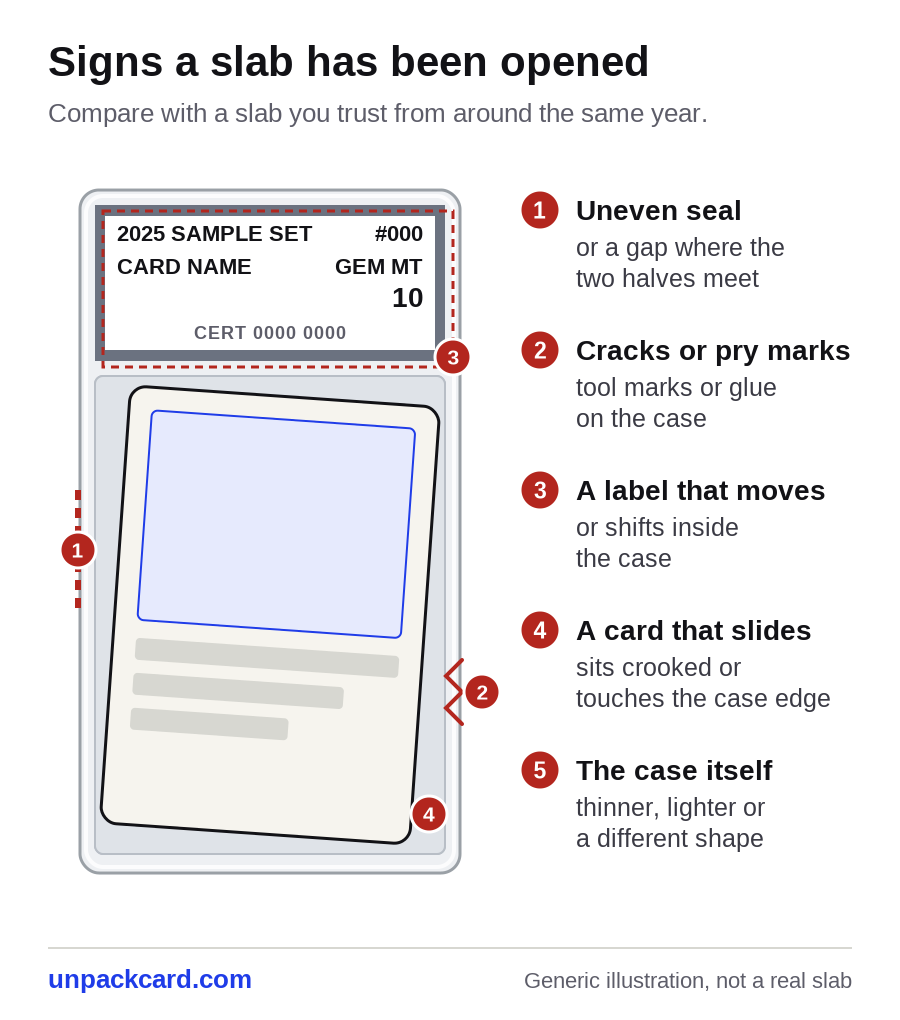
Check that the holder is sealed evenly all the way round and that nothing inside moves. A tampered slab often shows cracks, pry or tool marks, glue, or a gap where the two halves meet.
Hold the slab up and tilt it. The card should sit straight and snug in its inner holder, and the label should not shift. A card that slides, sits crooked or touches the case edge, or a label that moves, are all signs the case has been opened.
Also compare the size and feel with a slab you trust: a case that seems thinner, lighter or a different shape is a reason to stop.
Do CGC and Beckett slabs have the same checks?
Yes: the same six checks work for CGC and Beckett (BGS) slabs, using each grader's own lookup. For CGC, enter the cert number at cgccards.com/certlookup. For BGS, use the card lookup on beckett.com.
Each grader's label carries its own details, so match those too: on a CGC 10, check whether the label says Pristine 10 or Gem Mint 10; on a BGS label, check the four subgrades. Our guide to PSA vs CGC vs BGS grades explains what each label means.
Whatever the grader, be careful with QR codes and links opened outside the grader's own site or app. Fake slabs can carry QR codes that open copied verification pages, so type the grader's address yourself and enter the number by hand. Never rely on a verification link or screenshot the seller sends.
Buying a slab in Malaysia: what should I ask the seller before paying?
Ask for the cert number first, then look it up yourself while you talk. A seller who will not share the cert number of a slab they are selling has answered your question. Our guide to where to buy graded cards in Malaysia compares the channels.
Ask for clear photos of the front and back of the actual slab in daylight, not stock images, and a short video tilting it so you can see the hologram and the seams. Ask whether the slab has ever been re-cased, how it will be packed and insured, and what happens if it arrives damaged or does not match the record. Keep the answers in writing.
Pay where you can dispute the sale. On a marketplace, stay on its own checkout and chat; a seller who moves you to private messages and a direct bank transfer is removing your protection. Before transferring money to a person, check their bank account and phone number on Semak Mule, the Royal Malaysia Police portal at semakmule.rmp.gov.my. A 'no record' result is not proof of safety, but a match is a clear reason to stop.
Businesses selling online in Malaysia must show who they are. The Consumer Protection (Electronic Trade Transactions) Regulations 2012, in force since 1 July 2013, require anyone selling goods through a website or online marketplace to show their name or business name, their registration number where one applies, contact details, a description of the goods, the full price including delivery and taxes, payment methods, terms and conditions, and an estimated delivery time.
What should I do if I was sold a fake slab?
Keep every record, contact the seller and the platform quickly, and do not pass the slab on. Photograph the slab front and back, and save the listing, the chat, the payment receipt and the cert lookup result.
Ask the seller for a refund first, then open a dispute through the marketplace or your payment provider. If you think you have been scammed, call the National Scam Response Centre on 997 straight away and make a police report. Against a business, a consumer can also file a claim with Malaysia's Tribunal for Consumer Claims (Tribunal Tuntutan Pengguna Malaysia) through its e-Tribunal system online.
Tell the grader too: a fake label carrying a real cert number affects the owner of the genuine slab as well. For fake raw cards rather than slabs, our guide on how to spot fake Pokémon cards covers the card checks.
Does UnpackCard sell graded slabs?
UnpackCard, the site publishing this guide, is a Pokémon TCG shop in Malaysia run by PROSPER CHOICE SDN. BHD. Its Shop lists PSA-graded slabs and sealed product bought to order, mainly from a Malaysian distributor and also from established online sellers; you can browse now, and ordering opens soon. Demo: no real payments, nothing ships yet.
The checks on this page apply to us as much as to anyone: ask for the cert number of any slab and look it up yourself. Questions about how the Shop works are answered on our help page.
Sources
- PSA: certification lookup
- PSA: frequently asked questions (PSA App cert verification, SecureScan images)
- PSA: card grading standards (grade names)
- CGC Cards: certification lookup
- Royal Malaysia Police: Semak Mule
- Malaysia government portal: NSRC 997 hotline
- Consumer Protection (Electronic Trade Transactions) Regulations 2012 (P.U. (A) 458)
- Tribunal for Consumer Claims Malaysia (TTPM)